Search has fundamentally changed in the last couple of years. Google’s rolling out AI Overviews. ChatGPT’s answering questions that used to send people to websites. Perplexity’s citing sources directly in their responses. The old playbook of “rank high, get clicks” doesn’t work the same way anymore.
The game shifted from getting your link on page one to getting your content inside the answer itself. Whether that’s a Google AI Overview, a ChatGPT response, or a Perplexity citation, visibility now means showing up where AI tools are pulling information from.
At the same time, Google’s evaluation of content got stricter. Expertise, experience, authoritativeness, and trustworthiness (E-E-A-T) matter more than ever. The volume of AI-generated content flooding search results forced this shift. If your content doesn’t demonstrate real expertise and provide unique value, it’s getting buried.
How AI Search Actually Works (Without the Tech Jargon)

Search engines evolved through stages. First came RankBrain, then BERT, then MUM, and now we’re in the era of full AI-generated answers. Three major changes happened:
Search results changed from lists of blue links to synthesised direct answers. Optimisation changed from ranking for keywords to contributing to those answers. The underlying technology changed from static ranking algorithms to probabilistic content retrieval systems that understand context and meaning.
What this means in practice: your content needs to be designed for retrieval, not just ranking. AI systems are looking for clear, concise, authoritative information they can pull into answers. If your content is buried in long paragraphs, lacks structure, or mixes too many topics on one page, AI tools will skip it even if it ranks well traditionally.
The AI Search Engines You Need to Optimise For
Google AI Mode
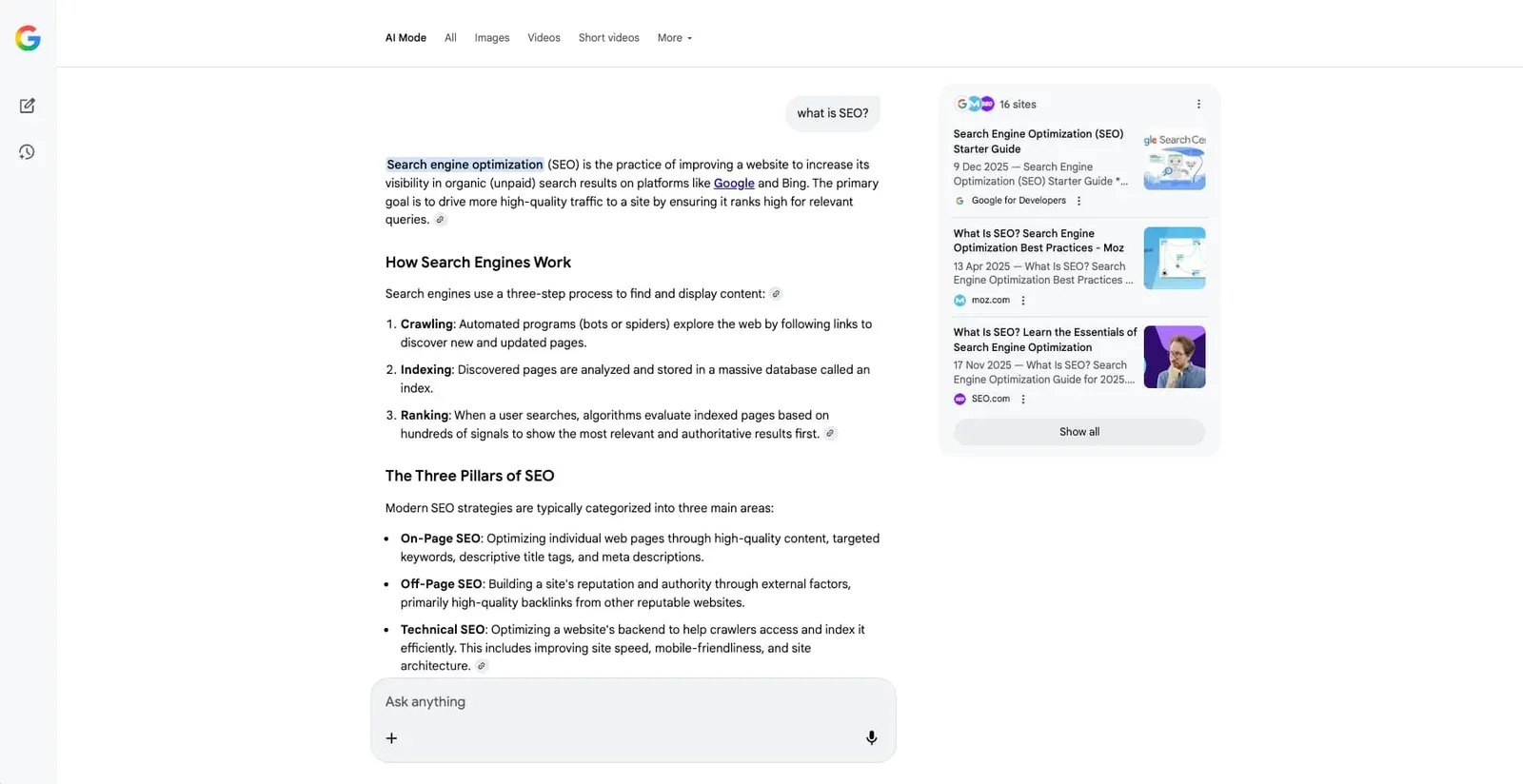
Google’s blending traditional ranking signals with generative answers. To show up here, you need clean page structure, proper schema markup, consistent entity data, and strong E-E-A-T signals. Your content needs to be easy for Google to summarise and pull into AI Overviews.
For local businesses, your Google Business Profile data, reviews, and off-site authority signals all feed into whether you appear in AI-generated local results.
ChatGPT Search
ChatGPT uses Bing’s search index combined with its own language model. It favours structured, concise content with clear topic boundaries. Shorter, focused pages perform better than massive encyclopaedic guides. Proper schema markup, strong headings, well-defined entities, and consistent terminology increase your chances of being cited. Brand trust signals and unique information help you stand out from generic content.
Perplexity
Perplexity relies heavily on real-time web crawling and prefers content that’s easy to quote directly. Short sentences, clean section breaks, verifiable statements, and clear sources work best. Pages with strong schema, factual clarity, and tightly scoped topics get cited more often. Regular content updates also improve your visibility here.
The New Rules of AI SEO
Google’s been clear about this: the same core SEO fundamentals still apply to AI Overviews and AI Mode. There’s no secret tricks or special tags. It’s solid SEO applied to an answer-first world.
Bing’s AI search team confirmed what we’re seeing in practice: success now depends on visibility inside AI answers, not just click-through rates. Impressions, citations, and placement in AI-generated summaries have become conversion signals themselves.
Here’s what works now:
Build focused pages that answer one specific intent clearly. Add short answer blocks at the top of sections. Use comprehensive schema markup and consistent entity references. Create topic clusters with clean internal linking. Focus on providing unique information, not just hitting word counts. Keep content updated regularly. Make sure your site is fast, crawlable, and well-structured. Use AI tools to speed up research and content creation, but refine everything with human expertise.
Rule 1: Write for Retrieval, Not Just Rankings
AI systems extract the clearest, most relevant information, not necessarily the highest-ranking page. They favour concise, tightly scoped content over broad pages that try to cover everything.
Create dedicated pages that answer one question or intent clearly. This reduces noise and makes it easier for AI to select your content when generating answers.
Rule 2: Make Your Content Easy to Extract
Short paragraphs, structured formatting, and clear headings help AI interpret and extract your content. Starting sections with direct answers increases the likelihood that your content becomes the chosen snippet in AI Mode.
Clean formatting benefits both human readers and AI systems. It improves readability and increases citation rates across all AI search platforms.
Rule 3: Schema Markup Actually Matters Now
Schema markup tells AI exactly what your content represents. Article schema, FAQ schema, HowTo schema, Organisation schema, and Person schema all improve how AI systems understand and retrieve your content.
Proper schema builds trust and strengthens entity recognition, which directly impacts your visibility in AI-generated answers.
Rule 4: Build Topic Clusters to Prove Authority
A hub-and-spoke structure of interlinked pages signals depth and expertise on a topic. AI systems recognise this pattern and see you as an authoritative source, not just a single isolated article.
Strong internal linking across related pages increases the probability that AI selects your content when generating answers on that topic.
Rule 5: Build Brand Mentions and Off-Site Signals
AI search engines rely on off-site signals to verify credibility. Digital PR, quality backlinks, and consistent citations help AI understand when to recommend your brand.
Brand mentions across trusted publications, industry sites, directories, and review platforms reinforce your authority and improve your likelihood of being cited in AI answers.
How to Actually Do AI SEO (Step by Step)
Step 1: Research Intent Using AI-Aware Tools
Use Semrush, Ahrefs, and AI research tools to find conversational queries, long-tail keywords, and follow-up questions. Map user intent and identify content gaps where AI systems need clearer information.
Step 2: Create Focused Pages, Not Massive Guides
Build pages that address one question or intent thoroughly. Break large topics into smaller, high-clarity pages. Focused content is easier for AI systems to retrieve and cite accurately.
Step 3: Write Extractable Answers
Start each section with a clear, direct answer. Follow with short paragraphs, lists where appropriate, and well-defined headings. Make your content easy for AI to lift into summaries and generated answers.
Step 4: Implement Schema and Consistent Entities
Add comprehensive schema markup including Article, FAQPage, Person, Organisation, and HowTo where relevant. Keep entity names consistent across your site and link related pages to reinforce topical clarity.
Step 5: Update and Expand Regularly
Refresh pages with new data, examples, and insights. Add new focused pages as search behaviour evolves. Fresh content signals relevance to both traditional search and AI systems.
Step 6: Strengthen Off-Site Authority
Build brand mentions through digital PR, authoritative backlinks, and consistent citations. Getting mentioned in reputable publications, industry sites, and directories helps AI validate your credibility and increases citation rates.
Why Massive Pillar Pages Don’t Always Win Anymore
Long comprehensive pillar pages still work for traditional SEO. But they often fail in AI-powered retrieval.
AI retrieval systems struggle with long pages covering multiple topics. They prefer tight, coherent content chunks. Systems using embeddings or retrieval-augmented generation work better with focused pages that have clear topic boundaries.
Even if your 5,000-word pillar page ranks well in Google, AI tools might skip it entirely and cite a smaller, clearer page instead. Your massive guide might rank, but AI models often ignore it when generating answers.
AI SEO Tools Worth Using
Ahrefs is our go-to for keyword research, competitor analysis, content gap identification, and backlink analysis. It provides the traditional SEO data that still feeds into AI retrieval systems, plus solid tracking for how your content performs across search. Peec.ai helps monitor AI Overviews and track where your content appears in generative answers. SEO Gets is useful for identifying AI search opportunities and brand mentions across LLM platforms.
AI content tools can speed up research, outlining, and first drafts. Use them for ideation and efficiency, then refine everything with human editing to maintain accuracy and depth. Schema Markup Validator helps you validate structured data and fix errors that prevent AI systems from properly reading your content.
Free tools still work fine. Paid versions add scale, automation, and auditing features useful if you’re managing enterprise-level content.
When to Get Help With AI SEO
Consider bringing in specialists when you need consistent entity structures across hundreds of pages, want to track AI visibility at scale, manage multiple languages or regional content, or lack internal bandwidth for regular updates and structured content workflows.
AI SEO services help implement comprehensive schema, manage topic clusters, monitor AI citations, and scale content updates across large sites.
Final Thoughts
Search changed. AI now sits between your content and potential customers. But the fundamental objective hasn’t changed: provide clear, useful, trustworthy information.
Adapt your content for both machines and humans. Make it easy for AI to find, understand, and cite your expertise. Do that and you’ll stay visible where your customers are actually searching.
Want help optimising your content for AI search? Our team’s been implementing these strategies across hundreds of Australian businesses. Let’s talk about getting your brand visible in AI-generated answers.
FAQ
What is AI SEO?
AI SEO is structuring your content so AI systems like ChatGPT, Google’s AI Mode, and Perplexity can recognise it, trust it, and cite it in their generated answers.
Why doesn’t my long content appear in AI answers?
AI retrieval favours short, focused pages that answer one intent cleanly. Long pages mixing multiple topics create unclear signals and are harder for AI to extract useful information from.
How do I get cited in Google AI Overviews or ChatGPT?
Provide clear answers, use clean headings, add proper schema markup, keep entity references consistent, and build a strong topic cluster around your subject. AI systems select content that’s easy to parse and clearly authoritative.
What’s the first step to start AI SEO?
Start with intent research. Use tools like Semrush or Ahrefs to find conversational queries and questions your audience is asking. Then build focused pages that answer single intents directly with clear, extractable information.