Google Ads will spend your budget on whatever searches it is allowed to. Some of those searches have produced leads for years. Most never have.
Take a demolition company in Sydney we run Google Ads for. In the 12 months to September 2026, 848 different search terms got a click on its ads. 137 of them produced a lead. And 44% of the spend Google’s search terms report could see went to searches that had never converted once.
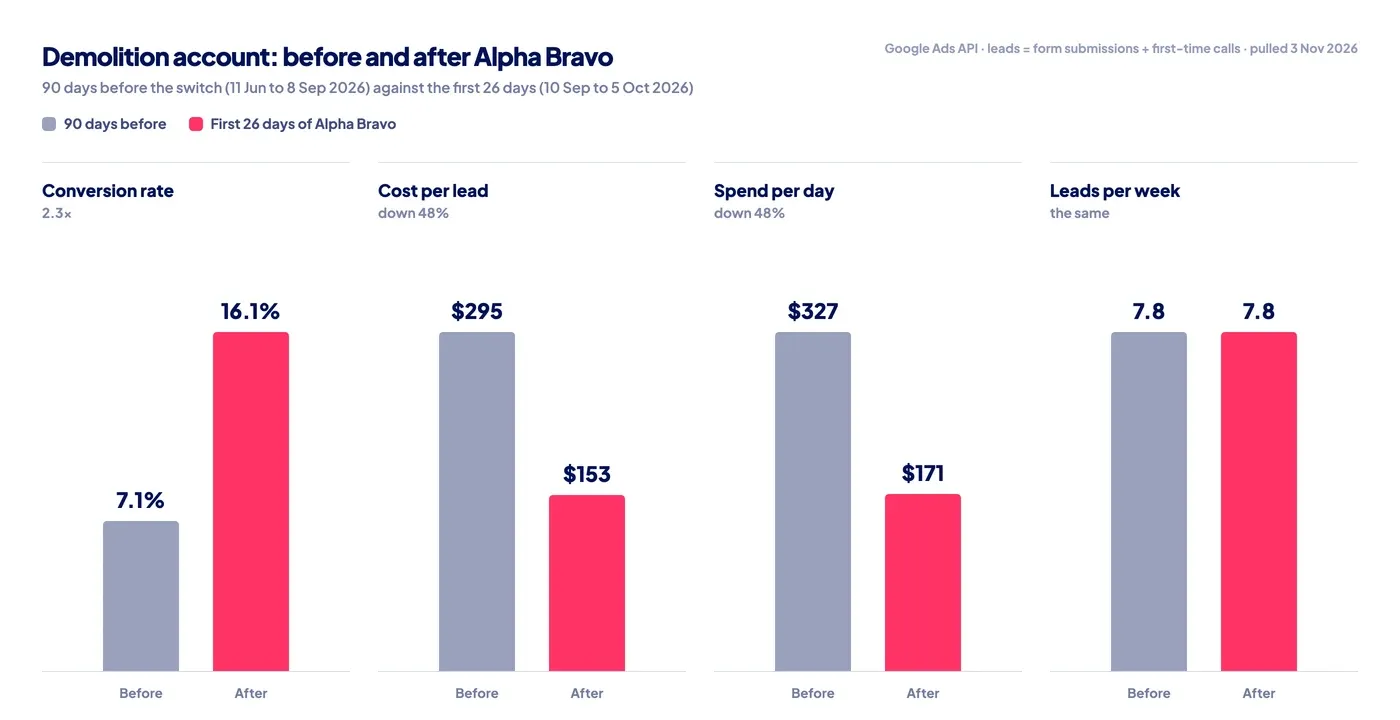
So in September I rebuilt the account around one idea: put the searches that are proven to convert in one campaign with their own budget, and let a second campaign go looking for new ones. Over the first 26 days the conversion rate went from 7.1% to 16.1% and cost per lead fell from $295 to $153. The business got the same number of leads a week for 48% less spend.
The structure is called Alpha Bravo. I ran through it on Instagram:
This post covers how it works, how I built it on the demolition account step by step, and the numbers that came out of it.
What is the Alpha Bravo campaign structure?
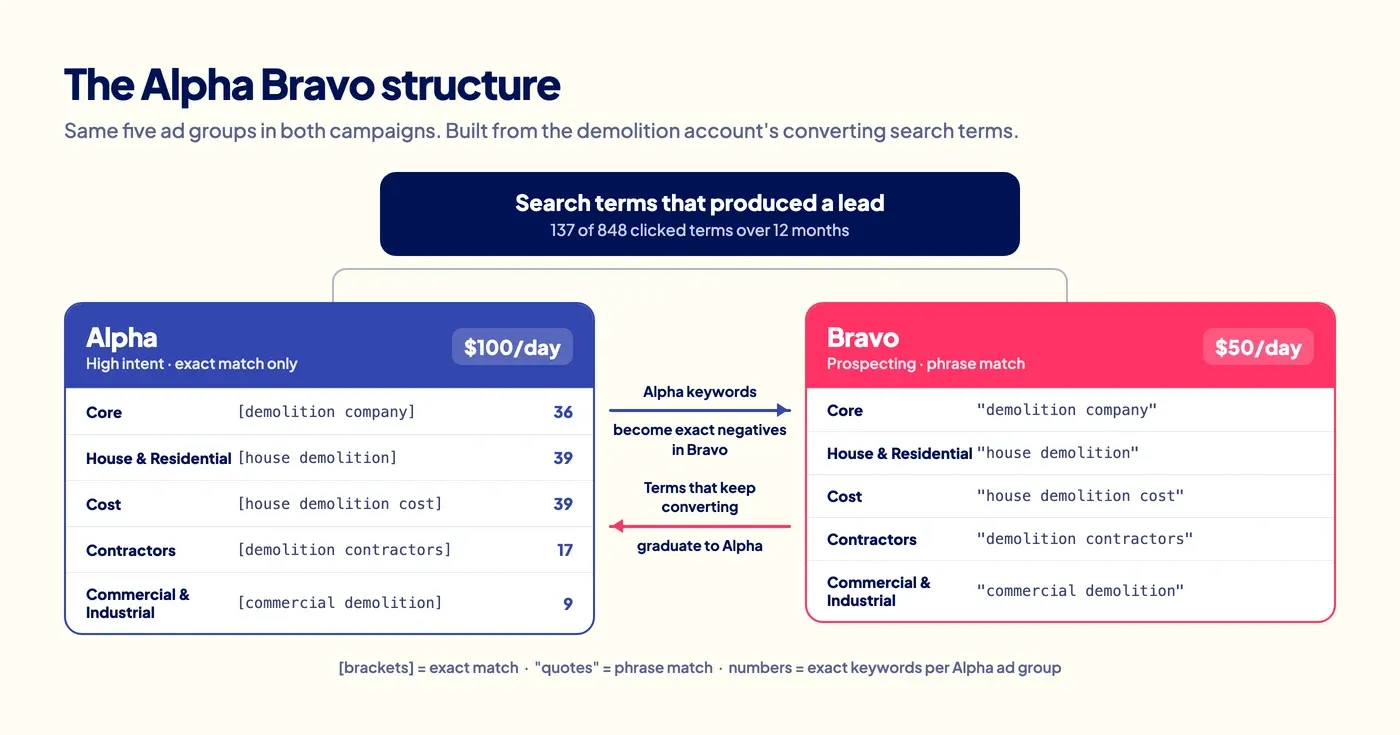
Alpha Bravo is a Google Ads search structure with two campaigns that share the same ad group themes.
Alpha is the high intent campaign. It holds exact match keywords only, and every one of them comes from a search term that has already produced a lead. It has its own budget, and that budget goes to proven money searches first.
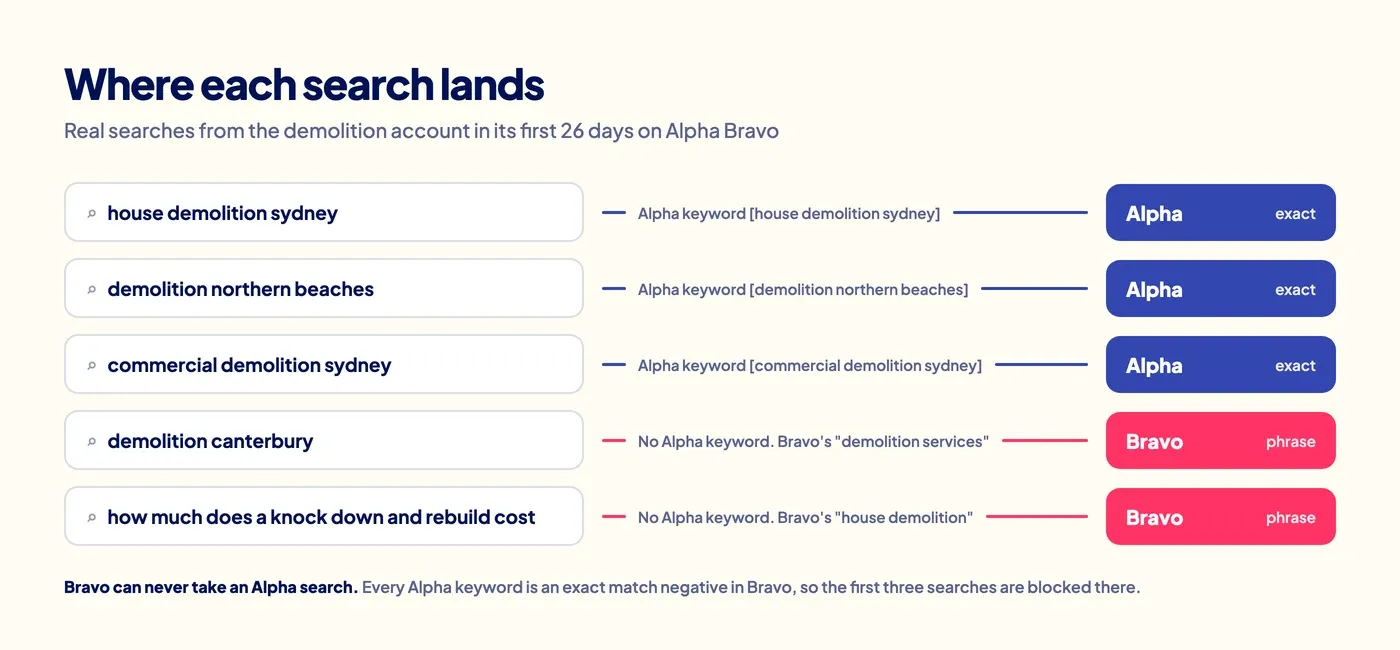
Bravo is the prospecting campaign. Same ad groups, same themes, but phrase match keywords. Its job is to find searches you have never paid for before. Every keyword in Alpha sits in Bravo as an exact match negative, so Bravo can never buy a search Alpha already owns.
When Bravo finds a search term that keeps converting, it graduates: it goes into Alpha as an exact keyword and onto Bravo’s negative list.
You will also see it called Alpha Beta, or a high intent and prospecting structure. Same mechanics under every name.
Why split proven searches from new ones
A single campaign that mixes everything has one budget and one bidding strategy trying to serve two jobs. Buying leads you know are there is one job. Testing searches you know nothing about is another. Smart Bidding can’t tell which job you care about more, so new and unproven searches compete for the same dollars as your best keywords.
Splitting them fixes four things.
- Proven searches get paid for first. Alpha’s budget can only be spent on exact matches of searches that have produced leads. Nothing else can eat it.
- Exploring has a ceiling. Bravo gets a smaller budget. If it has a bad week finding duds, the damage stops at that budget.
- Each bidding strategy learns from cleaner data. Alpha’s conversion data comes from high intent searches. Bravo’s comes from discovery. Each campaign’s Maximise Conversions bids on its own kind of traffic.
- The campaigns never compete. Because every Alpha keyword is an exact negative in Bravo, a search can only land in one place.
That fourth point is easiest to see with real searches from the demolition account:
How I built it on the demolition account
The account had been running for over a year when I rebuilt it. Over the 90 days before, seven campaigns had spent money: a broad match campaign, a suburb campaign holding 1,034 phrase match keywords, a main demolition campaign mixing exact and phrase match in the same ad groups, plus excavation, commercial, display retargeting and a short-lived alternative keywords test. It averaged $327 a day.
Here is what I did, in order.
1. Pull every search term that converted in the last year
I exported the search terms report for the previous 12 months and kept the ones with at least one conversion. That left 137 search terms, out of 848 that had got a click. Everything else had cost money and produced nothing.
Fix your tracking before you trust this list. When I audited this account, an old form tag was firing on the same submissions as the current one, so every form counted twice. Build Alpha off double counted conversions and you will promote the wrong searches.
2. Group the converting terms into themes
The demolition searches among them fell into five themes, and those became the ad groups. (The rest were asbestos, excavation and brand searches, which stayed in their own campaigns.)
| Ad group | Exact keywords in Alpha | Example keywords |
|---|---|---|
| House and residential | 39 | house demolition, residential demolition, demolish house |
| Cost | 39 | demolition cost, house demolition cost, cost to demolish house |
| Core | 36 | demolition company, demolition companies sydney, sydney demolition |
| Contractors | 17 | demolition contractors, residential demolition contractors |
| Commercial and industrial | 9 | commercial demolition, warehouse demolition, industrial demolition |
Price searches look like tyre kickers, but in demolition they convert. Somebody typing “how much does it cost to demolish a house” has a house they want gone. In the first 26 days that search produced two leads in Alpha from $13 of spend, as a close variant of the exact keyword “demolition a house cost”.
3. Build Alpha: exact match only, own budget
The Alpha campaign got the five ad groups and 140 exact match keywords. 41 of them are converting search terms word for word. The rest are close variants of those: plurals, “near me” and “sydney” versions, and the other ways people word a price search. It got a budget of $100 a day and Maximise Conversions bidding.
Each ad group got its own ads, written to the theme. The Cost ads lead with “House Demolition Cost” and “Free On-Site Quote”. The Commercial ads lead with “Demolition For Developers” and “Keep Your Project On Schedule”.
4. Build Bravo: same ad groups, phrase match
Bravo is an exact copy of the structure, with 27 phrase match keywords across the same five ad groups (“house demolition”, “demolition cost”, “commercial demolition” and so on). Budget: $50 a day, also on Maximise Conversions.
5. Add every Alpha keyword to Bravo as an exact negative
The Alpha keywords went into Bravo as exact match negatives. Bravo also carries the account’s long list of phrase negatives for searches the business never wants: jobs, courses, tenders, scrap metal, DIY, plant and skip hire, other trades, and towns outside the service area.
6. Switch over
Both campaigns went live on 9 and 10 September, and the old demolition campaigns stopped on 9 September. I did not run them side by side.
The results
The comparison below uses the 26 days from 10 September to 5 October against the 90 days before the switch (11 June to 8 September). After 5 October other changes went into the account, so the clean window stops there.
A lead is counted the same way in both periods: a contact form submission or a first-time phone call from the ads. Repeat callers and the duplicate form tag are left out.
| Metric | 90 days before | First 26 days of Alpha Bravo | Change |
|---|---|---|---|
| Conversion rate | 7.1% | 16.1% | 2.3x |
| Cost per lead | $295 | $153 | down 48% |
| Spend per day | $327 | $171 | down 48% |
| Leads per week | 7.8 | 7.8 | same |
| Click-through rate | 4.1% | 6.8% | up 66% |
| Cost per click | $21.05 | $24.71 | up 17% |
The cost per click went up, and that is the structure working. Exact match on proven searches means paying full price for the clicks that turn into jobs. The account stopped buying cheap clicks that never turned into anything, so it needed fewer clicks for the same leads: 6.9 a day against 15.6.
The click-through rate jump comes from the same place. An ad written for “house demolition cost” shown to someone searching “house demolition cost” gets clicked.
What each campaign did
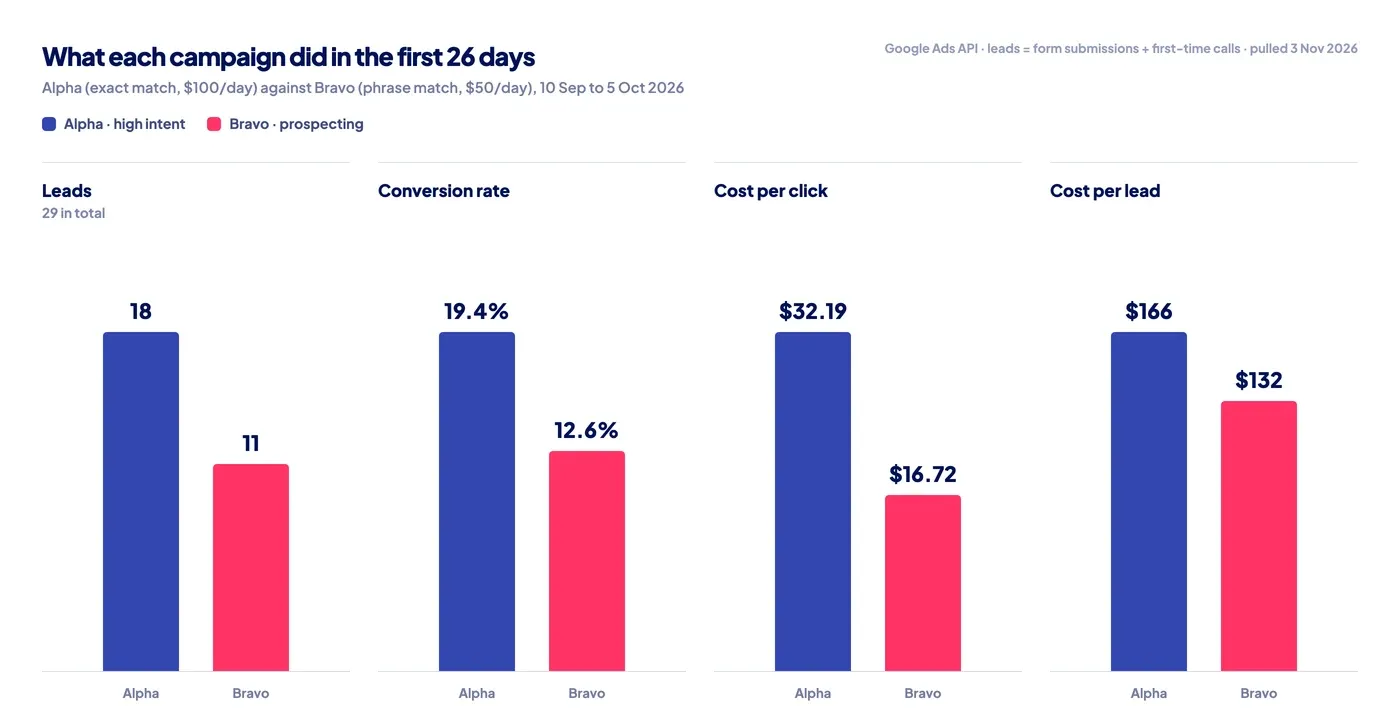
| Alpha (high intent) | Bravo (prospecting) | |
|---|---|---|
| Spend | $2,994 (67%) | $1,455 (33%) |
| Leads | 18 | 11 |
| Conversion rate | 19.4% | 12.6% |
| Cost per click | $32.19 | $16.72 |
| Cost per lead | $166 | $132 |
Alpha did what it was built for: one in five clicks became a lead. Bravo converted less often, but its phrase match clicks cost half as much, so its leads came in cheaper. That is the case for keeping a prospecting campaign running. It found 11 leads Alpha would never have seen.
Moving winners from Bravo to Alpha
Bravo’s search terms report is where the next Alpha keywords come from. In the first 26 days it produced a lead from “demolition canterbury”, a suburb Alpha had no keyword for, through the phrase keyword “demolition services”.
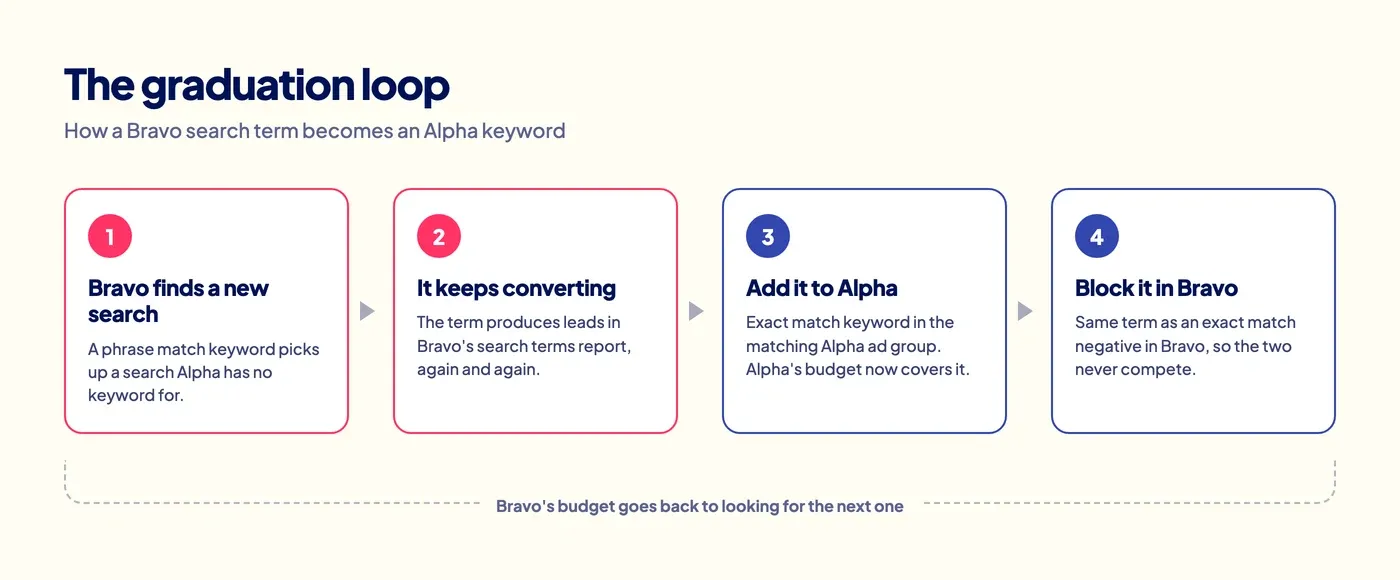
The move takes two minutes:
- Add the search term to the matching Alpha ad group as an exact match keyword.
- Add the same term to Bravo as an exact match negative.
Do both together. Skip the second step and the two campaigns start bidding against each other for the term you just promoted.
Once a term has moved, Alpha’s budget covers it and Bravo’s budget is free to go looking for the next one. Over months, Alpha grows into a list of every search that pays for itself, and Bravo keeps a fixed cost on finding more.
When Alpha Bravo works, and when it does not
It needs conversion history. This account had 137 converting search terms to build from. A brand new account has none, so start with a phrase match campaign that acts as Bravo, and build Alpha once a few search terms have converted more than once.
It needs honest conversion tracking. Alpha is only as good as the list of terms that “converted”. If a tag double counts, or a page view counts as a lead, you will build Alpha from the wrong searches.
It needs enough budget to run two campaigns. Splitting $30 a day in two leaves each campaign too little to learn from. If your budget is that tight, put it all into exact match keywords that have converted and skip prospecting until you can fund it.
If you are not sure what your account should be spending in the first place, start with how much Google Ads costs and how long it takes to work. For the bidding side, see the bidding strategies your competitors don’t know.
We build and run accounts this way for Australian service businesses. If you want us to look at yours, our Google Ads team will pull your converting search terms and show you what an Alpha campaign would look like in a free proposal.
Questions people ask
What is the Alpha Bravo campaign structure in Google Ads?
Two search campaigns built on the same ad group themes. The Alpha campaign holds only exact match keywords taken from search terms that have already converted, with its own budget. The Bravo campaign holds phrase match versions of the same themes to find new converting searches, and every Alpha keyword is added to it as an exact match negative so the two never compete. Search terms that keep converting in Bravo move into Alpha.
Is Alpha Bravo the same as Alpha Beta?
Yes. Alpha Beta is the older name for the same idea: an exact match campaign for proven searches and a looser campaign for discovery. It is also called a high intent and prospecting structure. The mechanics are the same under every name.
Should the Alpha campaign be exact match only?
Yes. Exact match is what keeps the Alpha campaign on searches with a track record. The moment you add phrase or broad match keywords to Alpha, it starts buying the same unproven searches the Bravo campaign is there to test, and the budget split stops meaning anything.
How do you stop the Alpha and Bravo campaigns competing in the same auction?
Add every Alpha keyword to the Bravo campaign as an exact match negative. A search that exactly matches an Alpha keyword can then only be served by Alpha. Do it again every time you move a keyword across.
How should you split budget between Alpha and Bravo?
Give Alpha the larger share, because it buys the searches you already know produce leads. On the demolition account in this post, Alpha had $100 a day and Bravo $50 a day. Over the first 26 days Alpha took 67% of the spend and produced 62% of the leads.
Does Alpha Bravo work with Smart Bidding?
Yes. Both campaigns on the demolition account ran Maximise Conversions. Splitting proven and unproven searches into separate campaigns gives each bidding strategy a cleaner set of data to learn from, and each one a budget it cannot spend outside its own lane.