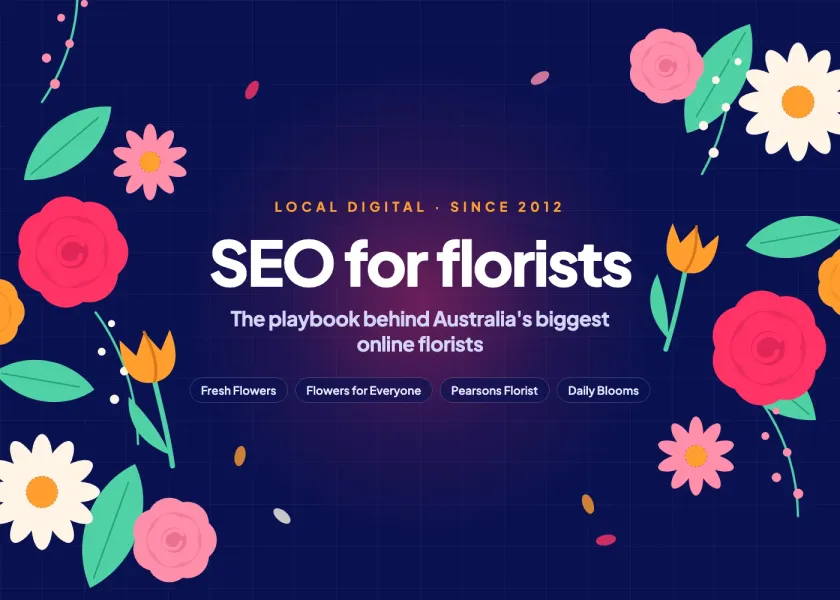
Since 2012 we have run search for four of the biggest online florists in Australia. Fresh Flowers, Flowers for Everyone, Pearsons Florist and Daily Blooms. Each of them hit its peak in Google while we were running it.
That is a rare thing to be able to say. Most agencies get one florist, if any. Flower delivery is one of the most expensive, most fought-over markets in Australian search: “flower delivery” alone sits at 27,100 searches a month at $6.37 a click, and “flower delivery sydney” costs $7.24 a click in Google Ads.
This post lays out exactly what we did for each brand, the numbers from Ahrefs, and the playbook we run on every florist. If you own an online florist and want more orders from Google and AI search, this is the plan.
Our track record with florists
| Brand | Years with us | What Ahrefs shows |
|---|---|---|
| Fresh Flowers | 2012 to 2015 | 285 keywords in Google’s top three when Ahrefs’ records begin in January 2016 |
| Flowers for Everyone | 2015 to 2019 | Estimated organic traffic up from 3,255 to 31,959 a month (about 10x) |
| Pearsons Florist | 2019 to 2022 | Estimated organic traffic up from 4,447 to 31,616 a month (about 7x), Domain Rating 20 to 33 |
| Daily Blooms | 2023 to 2026 | Estimated organic traffic up from 14,472 to 109,796 a month (about 7.6x), top three keywords 298 to 2,006 |
All of the traffic figures here are Ahrefs estimates of monthly visits from Google Australia, pulled on 3 November 2026. They are estimates. Where a client has shared their own analytics, the real numbers have been higher.
Fresh Flowers (2012 to 2015)
Fresh Flowers was our first florist, before Local Digital existed. It is where we first ran the playbook further down this page: suburb pages, occasion pages, flower type pages, and links underneath them.
Ahrefs’ records for freshflowers.com.au begin in January 2016, a few months after we finished. At that first reading the site held 285 keywords in Google’s top three and drew an estimated 10,713 visits a month.
Flowers for Everyone (2015 to 2019)
We started Local Digital in 2015 and signed Flowers for Everyone in the same year. We ran their search for four years.
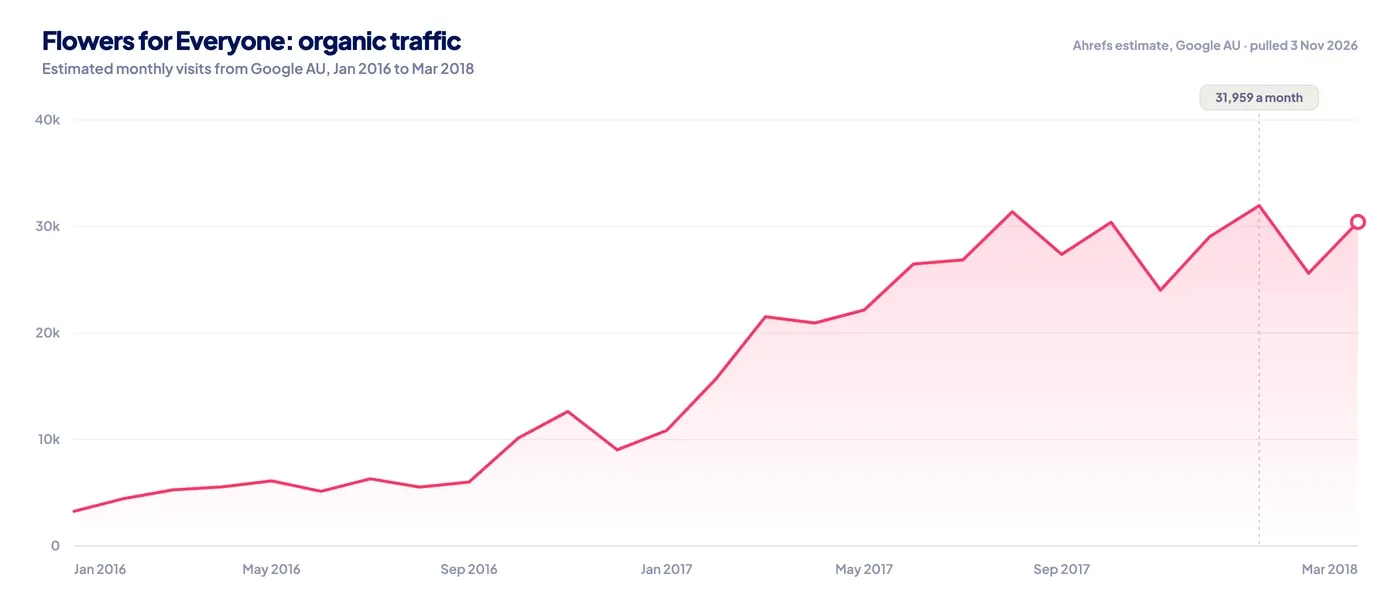
Between January 2016 and January 2018, estimated organic traffic went from 3,255 to 31,959 visits a month. Keywords in the top three went from 61 to 719 by March 2018.
Ahrefs also estimates what that traffic would cost to buy through Google Ads. For Flowers for Everyone it went from $5,586 a month to $51,100 a month. That is the value of the clicks they were getting for free, every month, at the peak.
Pearsons Florist (2019 to 2022)
Pearsons is a Sydney family business with more than 50 years of history and stores across the city. We signed them in 2019, the year Flowers for Everyone moved on. When they came to us most of their sales were going through the shops, and online revenue was going backwards.
We rewrote the metadata, headings and copy on every key page, fixed the technical problems common to ecommerce stores, and built suburb pages and hospital delivery pages across Sydney. Then we built links.
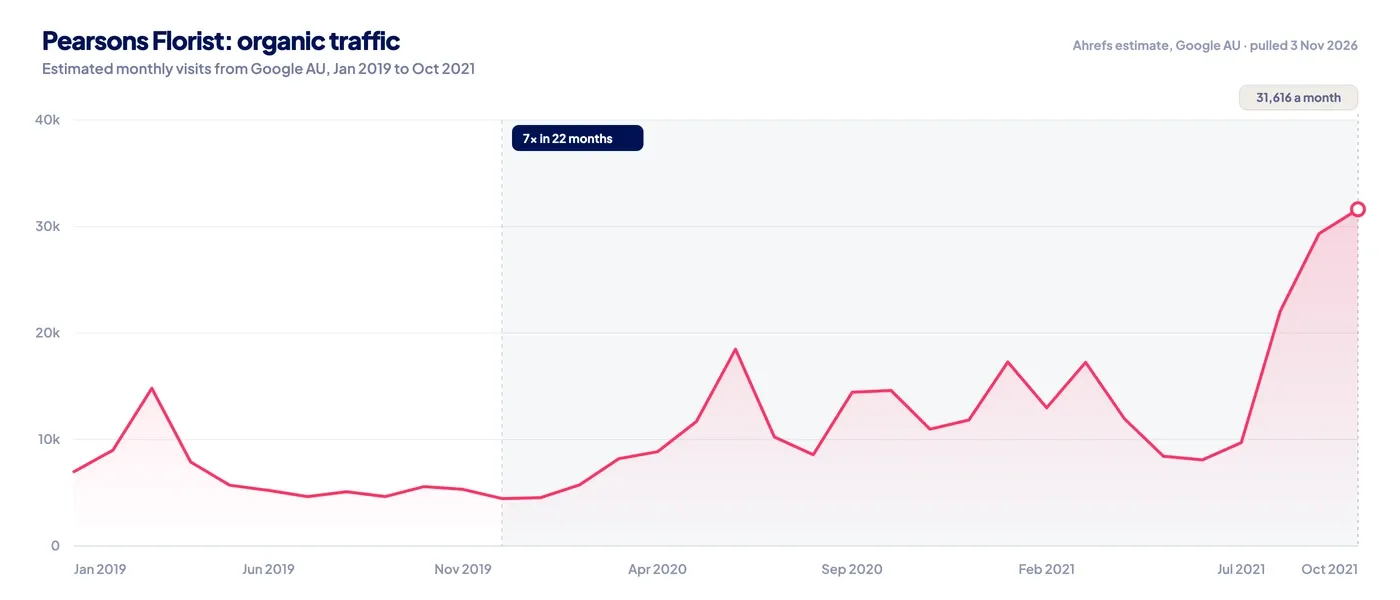
From December 2019 to October 2021, estimated organic traffic went from 4,447 to 31,616 visits a month. Their Domain Rating rose from 20 at the start of 2019 to 33 by November 2020, which is the link building showing up. The value of their organic traffic went from $7,086 a month to $50,458.
Their own numbers were better. Organic revenue doubled, and Pearsons ranked first in Google for “florist sydney”. The full story is in our Pearsons Florist case study.
Daily Blooms (2023 to 2026)
Pearsons finished with us at the end of 2022, and in early 2023 we signed Daily Blooms, a same-day online florist delivering across the capitals. They already had an SEO consultancy. A year of work with them had produced a flat line.
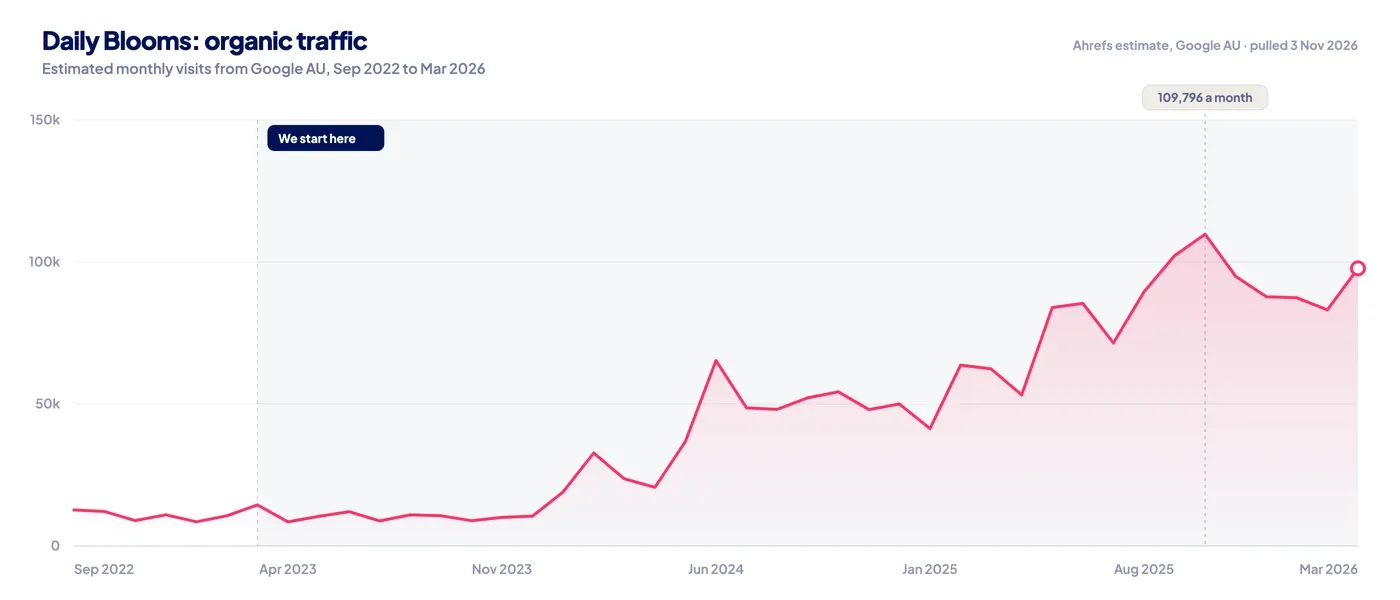
From March 2023 to October 2025, estimated organic traffic went from 14,472 to 109,796 visits a month. Their own Google Analytics shows organic traffic up tenfold. The value of their organic traffic, in Ahrefs’ terms, went from $19,611 a month to $177,559.
Look at the first nine months on that chart. Nothing much happens. Then the pages and links compound and the line goes vertical. Every florist we have grown has had a curve shaped like this, and it is the reason florists who quit SEO after six months never see the payoff.
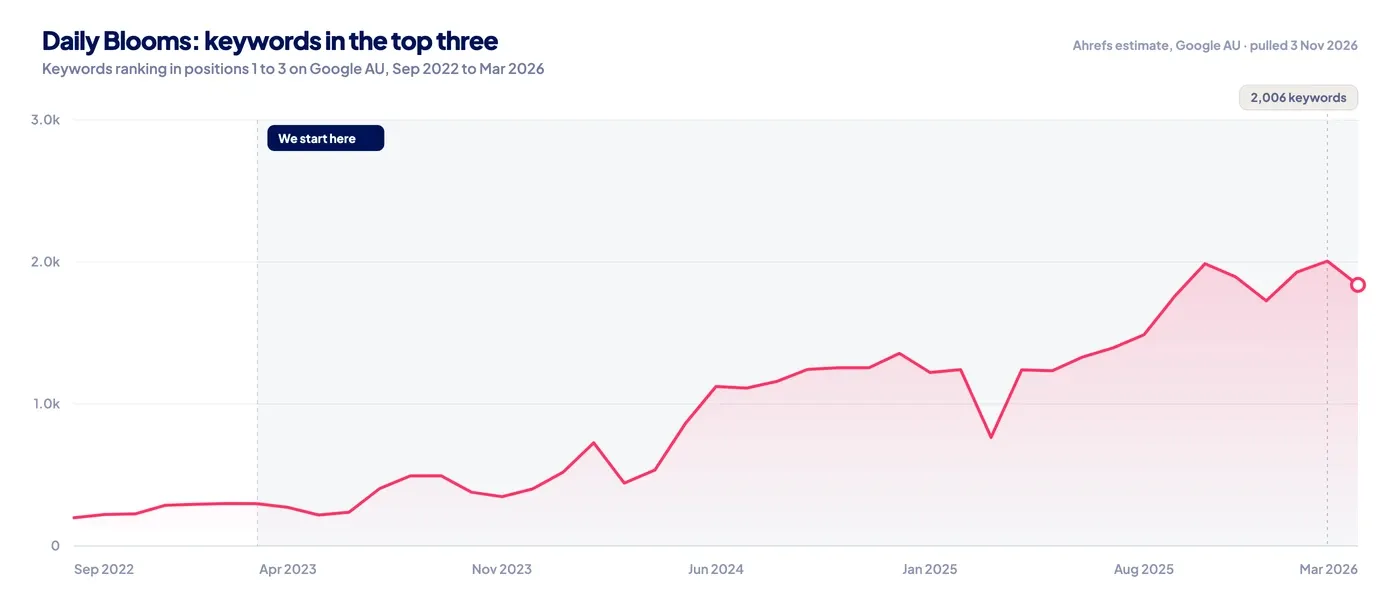
The number that matters most is keywords in the top three. Daily Blooms went from 298 to 2,006. Their Domain Rating went from 27 to 36 over the same stretch. The full story is in our Daily Blooms case study.
Where they rank today
Search for these brands right now and you will find them at the top.
| Search | Monthly searches | Ranking first |
|---|---|---|
| flower delivery melbourne | 8,000 | Daily Blooms |
| flower delivery sydney | 6,500 | Pearsons Florist |
| flower delivery brisbane | 4,100 | Daily Blooms |
| flower delivery perth | 3,800 | Daily Blooms |
| flowers delivery sydney | 2,200 | Pearsons Florist |
| send flowers melbourne | 800 | Daily Blooms |
Positions and search volumes are from Ahrefs for Google Australia on 1 November 2026. Daily Blooms also ranks second for “flower delivery” nationally (8,400 searches a month) and for “flower delivery gold coast”.
The florist SEO playbook
Every florist above got the same six page types. Each one answers a different buying moment, and each one is a search your competitors are probably ignoring.
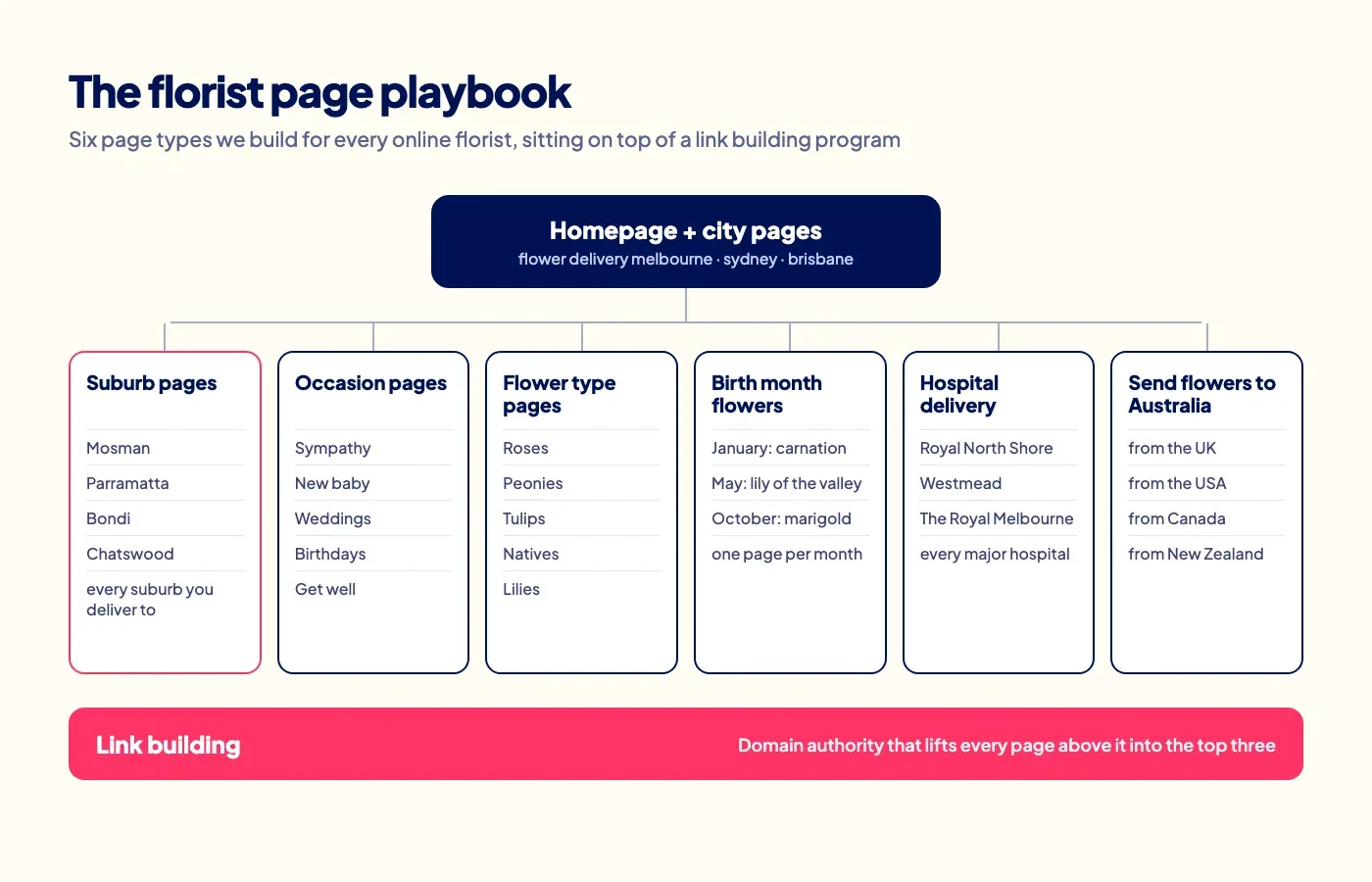
1. Suburb pages
A page for every suburb you deliver to. People search “flower delivery parramatta” (170 a month) and “flower delivery bondi” (140 a month), and Google prefers the florist with a page about that exact suburb.
One suburb looks small. A capital city has hundreds of them, and suburb pages rank faster than city pages because fewer florists bother to build them. Daily Blooms ranks fifth for “flower delivery sydney” with its Mosman page.
2. Occasion pages
Sympathy, new baby, weddings, birthdays, anniversaries, get well. Each occasion is its own search with its own buyer. “Birthday flowers” runs at 9,900 searches a month in Google Ads data, “funeral flowers” at 4,400, “wedding flowers” at 2,900, “sympathy flowers” at 1,900, “anniversary flowers” at 880 and “new baby flowers” at 720.
A funeral buyer and a new parent want different bouquets, different card wording and different delivery promises. One generic shop page can’t rank for both.
3. Flower type pages
Roses, peonies, tulips, natives, lilies. Some of these searches are huge (“peonies” is 40,500 a month) and mostly people looking at pictures. Others are ready to buy: “roses delivery” (480) and “native flowers delivery” (170). A good flower type page serves both, with a guide at the top and the products underneath.
Flowers for Everyone still ranks first for “australian native flowers” (6,100 a month) with exactly this kind of page.
4. Birth month flower pages
Every month has a birth flower: carnations for January, lily of the valley for May, marigolds for October. “Birth month flowers” and “october birth flower” each run at about 2,900 searches a month.
These pages bring in people who are planning a birthday gift and haven’t picked a florist yet. Twelve pages, written once, and they pull in buyers every month of the year.
5. Hospital delivery pages
“Royal North Shore hospital flowers” is 70 searches a month. Small. But that buyer has a person, a ward and a deadline, and is ready to order the moment they land.
We build one page for every major hospital in each delivery area: delivery times, ward rules, what the hospital allows (some wards ban flowers in water, some ban flowers altogether), and the arrangements that suit. Pearsons and Daily Blooms both carry them.
6. Send flowers to Australia pages
Someone in London wants flowers on a doorstep in Melbourne. They search “send flowers to Australia from the UK”. “Send flowers to australia” runs at 720 searches a month here, plus whatever comes from the UK, the US, Canada and New Zealand.
We build a page for each sending country, covering time zones, currency and delivery cut-offs. A buyer in another country can’t walk into a local shop, so the florist that ranks gets the order.
Links: the part most florists underfund
All six page types sit on top of a link building program. Without it, those pages index and sit on page three.
Flower delivery is a high-value market, so the florists at the top fund it properly. We have worked in this space for more than a decade, and many Australian florists are putting $10,000 or more a month into acquiring links. That spend lifts the authority of the whole domain, and every suburb, occasion and hospital page rides on it.
You can see it in the numbers. Pearsons’ Domain Rating went from 20 to 33 while we ran their links. Daily Blooms went from 27 to 36. Those moves came first, and the rankings followed.
If you are building pages and skipping links, you are paying for half a strategy. We cover how we run link building in a separate guide.
Google Ads for florists
SEO takes a year to compound. Google Ads pays from the first week, and for several of these brands we ran both.
On the florist Google Ads accounts we have managed, non-brand search returned $4 to $5 in revenue for every $1 spent. Non-brand is the number that matters: it counts only people who searched for flowers, not people who searched for your name and would have found you anyway. Plenty of agencies report a blended ROAS that leans on brand clicks. Ask yours to split it.
How we run them:
- Brand and non-brand in separate campaigns, with separate budgets and separate reporting.
- Shopping campaigns on the product feed, so the bouquet, the price and the delivery promise show before the click.
- Ads that land on the city, suburb and occasion pages the SEO work builds. A “sympathy flowers melbourne” ad lands on the Melbourne sympathy page, never the homepage.
- Budget planned around the peaks. “Mothers day flowers” reaches 40,500 searches a month and Valentine’s Day spikes the same way. Cost per click jumps in those weeks, so the budget has to be set before them.
The two channels feed each other. Ads data shows which suburbs and occasions convert, and that tells us which pages to build next. More on our Google Ads service.
SEO for florists in the age of AI
People now ask ChatGPT, Gemini, Perplexity and Google’s AI Mode where to order flowers. Those tools run a live web search and build the answer from the pages that rank.
So the playbook carries straight over. The florist with a page for every suburb, occasion and hospital, sitting on a strong domain, is the florist the AI finds when someone asks “who delivers flowers to Royal North Shore today?”. A florist with ten pages and no links doesn’t get mentioned.
The detail of how AI answers pick their sources is in our guide to getting cited in Google AI Overviews and ChatGPT.
Why florists come to us
We have grown more online florists in Australia than any agency we know of. Four brands, over 14 years, each at its peak while we ran it, and two of them still sitting first for flower delivery in Australian capitals today.
That history means we start where most agencies finish. We know which page types rank, how many links a capital city takes, what an occasion page needs to convert, and how the Mother’s Day budget should be set in March.
If you run an online florist and want to be the name at the top of Google and in AI answers, ask for a free proposal. We will show you where you rank today, which of the six page types you are missing, and what it would take to win your city. You can also read more about our SEO service and our ecommerce SEO work.
Questions people ask
What is the best way to grow an online florist?
Build a page for every way people search for flowers: every suburb you deliver to, every occasion, every flower type, birth month flowers, hospital delivery and international senders. Then build links to lift your domain's authority so those pages reach the top three. Run Google Ads on non-brand searches beside it. That is the playbook behind Daily Blooms, Pearsons Florist and Flowers for Everyone.
How long does SEO take for a florist?
On the florists we have run, the steep part of the curve arrived in the second year. Daily Blooms was flat for its first nine months with us, then went from about 10,500 to 65,000 estimated monthly visits between December 2023 and June 2024. Flowers for Everyone's biggest jump came in its second year with us. Plan on 12 to 24 months for the money terms.
Do florists need suburb pages?
Yes. People search for flower delivery by suburb (flower delivery Parramatta, flower delivery Bondi), and Google rewards the florist with a dedicated page for that suburb. Daily Blooms ranks fifth for flower delivery sydney with its Mosman page. Every florist we have grown had a page for every suburb it delivers to.
Is Google Ads worth it for florists?
Yes, if you measure it on non-brand searches. On the florist accounts we have run, non-brand Google Ads return $4 to $5 in revenue for every $1 spent. Brand searches return more, but those buyers were already looking for you.
How much do florists spend on link building?
The florists at the top of Google for flower delivery in Australian capitals spend $10,000 or more a month on links. Daily Blooms' Domain Rating rose from 27 to 36 while we ran their link building, and Pearsons went from 20 to 33.
Does SEO still matter for florists now that people use ChatGPT?
Yes. ChatGPT search, Gemini, Perplexity and Google's AI answers run live web searches and build their answers from pages that rank. A florist that ranks first in Google is the florist those tools find and quote.